.jpg)
Stacey Williams
student, artist, teacher
Stacey Williams is a Tlingit weaver and artist, descendant of the Saanya Kwaan (Cape Fox) tribe in southeast Alaska. She studied basketry and textiles in Ketchikan, AK where she apprenticed to Haida master weaver Holly Churchill. Under her guidance, Stacey learned how to teach youth techniques of weaving while perpetuating indigenous ways of being. She has been recognized by Sealaska Heritage Institute for her community impact in education and hosted as a resident artist virtually. Her dedication to learning and teaching resulted in a museum artist residency at Sheldon Jackson, several cultural camp artist instructor positions, and a full exhibit she curated at the Main Street Gallery in Ketchikan focused on her journey.
Stacey maintains connection to the fundamentals of her instruction having recently relocated from the Tongass rainforest that shaped her techniques. She continues her research with ancestral items while extending her studies to the mid-west of the continental states. Many creators remain unknown and unnamed in historical documents; their contributions and dedication to what is now defined as an art form remains a guide.
Numerous artists have been generous in continuing their forms through instruction. As a student, Stacey acknowledges Diane Douglas-Willard, Evelyn Vanderhoop, Dorica Jackson and Kathryn Rousso with gratitude.
Her works are on display with Ketchikan Museums and available for purchase through Crazy Wolf Studio and limitedly through Sealaska Heritage Store. Commissions are accepted at her discretion. She welcomes inquiries via email at staceywilliamsweaver@gmail.com
Weaving belongs to us all.
- A wise weaver
Learning Through Teaching was an educational and interactive exhibit curated by Stacey Williams encouraging all ages to learn about the Alaska Native weaving practices of Southeast in March of 2022 at the Main Street Gallery in Ketchikan, AK.
Scroll down to watch a short clip about the display!

selected works
here you'll find some results of intricate lessons for my most inspired pieces


form follows function
A phrase often repeated is “learn the rules first, then break them.” The understanding is rooted in relevance and intention. It is this mindset that believes students should learn and work with the best quality of prepared materials. Learning the techniques of a basketry form is similar to developing a handwriting style; composing any script with a faulty pencil would be difficult even for someone with excellent penmanship, let alone a beginner.
You don't simply put razor clams into a beach asparagus basket
Twelve More Generations
*selected in top twenty
This basket was submitted as part of the 2024 Young Tribal Leaders Art Contest, and selected by a committee of Division of Environmental Services and Cultural Resource Management (DESCRM) and Institute of Tribal Environmental Professionals (ITEP) staff. Three winners were selected*, this basket was included among the twenty additional exemplary works to exhibit online and at the Main Interior Building in Washington, DC.Incorporating 12 different skillsets learned through apprenticeships with master weavers in order to continue the thread of knowledge in this utilitarian type of horn spoon basket. Typically used along the northwest coast for transportation of personal items such as utensils in order to maintain order and cleanliness among the population and surrounding environment. Form follows function within usable creations; the impact of climate has undermined the need for certain types of baskets such as those used for harvesting shellfish due to all time recorded elevated PST (Paralytic Shellfish Toxin) levels.

Community Impact
In August of 2024, Stacey was invited to accept a community educator award from Sealaska Heritage Institute at their culturally responsive education conference, Our Cultural Landscape.
"[Stacey Williams] offers a variety of support to students and educators of all ages through small group, large group and individualized lessons. Private commissions, research consultations and other sales of her crafts support her efforts in cultural revitalization. She encourages each of her students to further the arts, maintain our ancestors’ path and embody the intention of “Our Way of Life.” She believes that through diligent dedication the arts were more than decorative; highly adorned utilitarian items showed elegant proof of our society prior to outside contact. She teaches that it is now our responsibility and honor to rediscover and practice the arts respectfully, thoroughly and with deep commitment."
-Sealaska Heritage Institute Press Release

Virtual Native Artist Residency
with Sealaska Heritage Institute
A total of 10 videos resulted from this residency including
interviews with mentors, live Q&A's and the instructional demonstrations shown below


Artist at Work
Artist at Work


cedar bark plaited hat start

cedar bark weaving

cedar bark diagonal plaiting

spruce root weaving
large open weave gathering basket
red and yellow cedar bark, private collection



Red Cedar Basket
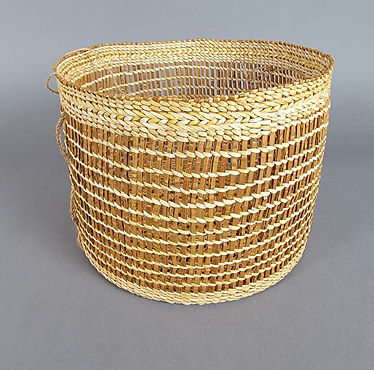
This piece is located in the educational collection at Ketchikan Museums and is available for research by request. The warps are doubled in place and Tlingit weaving techniques were implemented throughout. The open weave uses a basic 2-way twine and is followed by a 3-way twine that frames a twill design. The last of the four rows of twill is incorporated into the ending in conjunction with a final 3-way twine as all the warps are folded into their own place leaving a loop. After the weaving is completed each of the loops has a red cedar weft inserted and is carefully pulled down around to ensure a tight and solid ending for utilitarian use.
beaded hide collar
featured in the revolving student and instructors case at the Totem Heritage Center


